
A lot of people who own a CPAP machine aren’t actually using it most nights. The mask leaks, the hose gets tangled, the noise wakes up a partner, and eventually it ends up in a closet. If that’s you, you’re not failing at treatment. Plenty of people struggle with CPAP, and it doesn’t mean you have to go back to sleepless nights.
If that sounds familiar, there’s another path worth knowing about: a small, custom-made oral appliance, fitted by a dentist, designed to do the same job without the mask.
Can a Dentist Really Treat Sleep Apnea?
Yes, and it’s well within a dentist’s expertise; it’s a recognized area of dental sleep medicine. At Amelia Gentle Dentistry, Dr. Jackie Miller is a Qualified Dentist through the American Academy of Dental Sleep Medicine (AADSM), a credential that specifically covers the diagnosis-support and treatment of sleep-related breathing disorders using oral appliance therapy.
In practice, that means we work alongside your physician or sleep specialist, not around them, to determine whether an oral appliance is the right treatment for your specific case. Physicians can send patients through our sleep apnea physician referral page.
Prefer to listen? Hear Dr. Miller talk it through in our sleep apnea podcast episode.
How an Oral Appliance for Sleep Apnea Actually Works
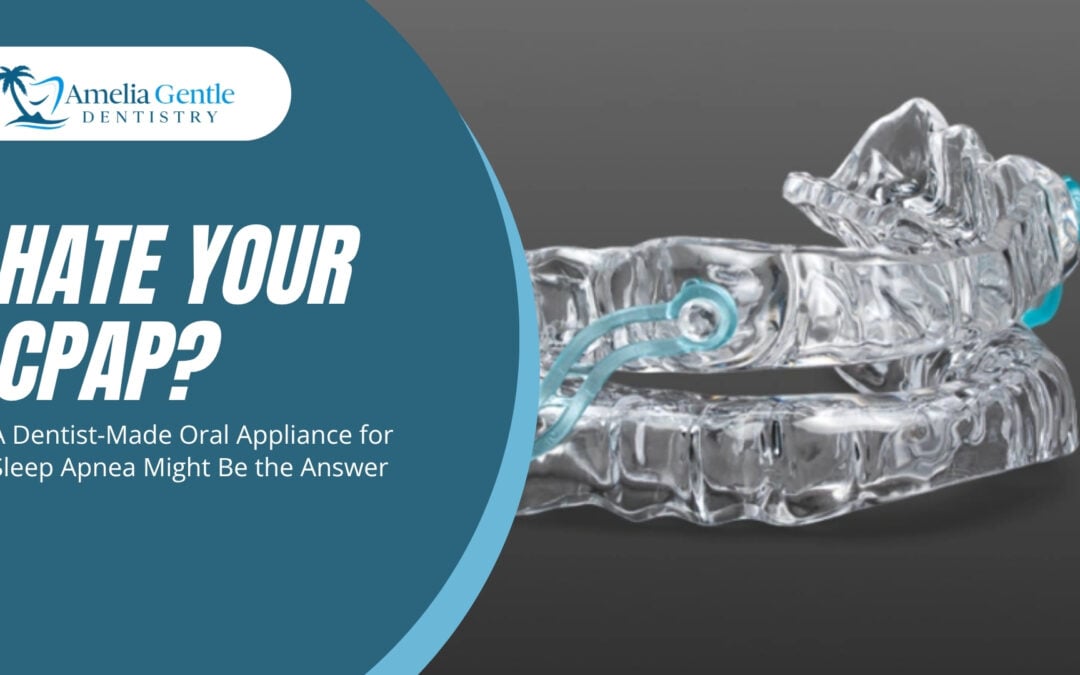
A dental sleep appliance looks similar to a sports mouthguard or a retainer. It’s worn only at night, and it works by gently repositioning your jaw, or holding your tongue in place, to keep your airway open while you sleep.
That’s the core mechanism behind obstructive sleep apnea in the first place, soft tissue collapsing and blocking the airway during sleep. By preventing that collapse, the appliance helps you breathe normally through the night without a mask, hose, or machine. You can learn more about our sleep apnea and snoring treatment options on our services page.
Oral Appliance vs. CPAP: Which Works Better?
For moderate to severe sleep apnea, CPAP is still generally considered the gold standard by sleep physicians. But the most effective treatment is the one you’ll actually use consistently, and CPAP compliance rates are notoriously low because many people simply can’t tolerate the mask long-term.
For patients with mild to moderate sleep apnea, or anyone who has tried CPAP and genuinely can’t adjust to it, an oral appliance is often a highly effective alternative. The right choice depends on your specific diagnosis, which is why this decision is made together with your sleep physician, not in isolation.
Does Insurance or Medicare Cover a Sleep Apnea Oral Appliance?
Often, yes, but typically through medical insurance or Medicare rather than dental insurance, since sleep apnea is classified as a medical condition. Coverage usually requires a formal sleep study diagnosis first.
We can help you understand what documentation is needed and what your specific plan is likely to cover before you commit to treatment. If part of the cost falls to you, ask us about our payment plans.
How Do I Know If My Snoring Is Actually Sleep Apnea?
Not all snoring is sleep apnea, but certain signs are worth paying attention to:
- Loud, frequent snoring most nights of the week
- A partner reporting gasping, choking, or pauses in your breathing during sleep
- Waking up with headaches or a dry mouth
- Daytime fatigue even after a full night in bed
- Difficulty concentrating during the day
Mayo Clinic’s overview of obstructive sleep apnea symptoms and causes is a helpful reference. And if constant tiredness is your biggest complaint, read why it may be an airway issue, not your schedule.
A home or in-lab sleep study is the only way to get an actual diagnosis, but if several of these sound familiar, it’s worth bringing up at your next visit, whether that’s with your physician or with us.
What to Expect When Getting Fitted for an Oral Appliance
If you already have a sleep study confirming obstructive sleep apnea, getting started with an oral appliance is a fairly straightforward process. We begin with a consultation to review your diagnosis and discuss whether an appliance is a good fit for your specific case, alongside your physician’s input.
From there, we take detailed impressions or digital scans of your teeth to design a custom appliance, rather than a generic one-size-fits-all device. Once it’s ready, we fit it in-office and make adjustments to the jaw positioning over a series of short follow-up visits, since comfort and effectiveness often need small, gradual refinements.
Most patients are surprised by how quickly they adjust to wearing it, especially compared to the learning curve of a CPAP mask and hose.
Ready to Stop Dreading Bedtime?
If your CPAP is sitting unused in a drawer, let’s talk about whether an oral appliance could work for you instead. Call Amelia Gentle Dentistry at 904-277-8500 or contact us online to schedule a consultation with Dr. Jackie Miller, our AADSM-Qualified dentist for sleep apnea care.
Frequently Asked Questions
Can a dentist really treat sleep apnea?
Yes. Dr. Jackie Miller at Amelia Gentle Dentistry is a Qualified Dentist through the American Academy of Dental Sleep Medicine, a recognized credential for treating sleep-related breathing disorders with oral appliance therapy, working alongside your physician or sleep specialist.
What is an oral appliance for sleep apnea and how does it work?
It’s a custom-fitted device worn at night, similar in appearance to a mouthguard, that repositions your jaw or tongue to keep your airway open, preventing the soft-tissue collapse that causes obstructive sleep apnea.
Do oral appliances work as well as CPAP machines?
For moderate to severe sleep apnea, CPAP is generally considered the gold standard. But for mild to moderate cases, or for patients who can’t tolerate CPAP long-term, an oral appliance is often a highly effective alternative, since the best treatment is the one you’ll actually use consistently.
Does medical insurance or Medicare cover a sleep apnea oral appliance?
Often, yes, typically through medical insurance or Medicare rather than dental insurance, usually requiring a formal sleep study diagnosis first. We help patients understand what documentation their specific plan will require.
How do I know if my snoring is actually sleep apnea?
Warning signs include loud, frequent snoring, a partner noticing gasping or pauses in breathing, morning headaches, dry mouth, and daytime fatigue despite a full night’s sleep. A sleep study is the only way to get a formal diagnosis.
Can a dental device stop snoring even without sleep apnea?
Yes. Some patients snore without meeting the criteria for sleep apnea, and a dental appliance can still help by keeping the airway more open at night. It’s worth a conversation to determine whether snoring alone or an underlying sleep apnea diagnosis is the right thing to address.